How to transfer photos and files from Android to a Mac
Over a cable it comes down to five things, in the order your hands meet them: a cable that carries data, the phone's USB mode, the lock screen, the app on the Mac, and the copy itself. Get the first three right and the Mac can see the phone. The fourth decides what you can copy.
Use a cable that carries data
Plenty of USB cables only charge. With one of those the phone fills its battery and the Mac never learns a phone is there, so nothing in the later stages can change the outcome. If the phone never offers you a choice of what to use USB for, try another cable before anything else, and plug straight into the Mac rather than through a hub.
Switch the phone to file transfer
Most phones start a USB connection charging only. Pull down the notification shade, tap the USB notification, and choose the file transfer option. Phones name it differently — File transfer, Transferring files, or MTP. It is not the same as Transfer photos, which is also called PTP, and the difference decides what the Mac can see.
| On the phone | What the Mac sees | Works with |
|---|---|---|
| Charging only, or No data transfer | Nothing at all | Nothing |
| Transfer photos (PTP) | A camera, holding your photo and video folders | Image Capture |
| File transfer (MTP) | The phone's whole shared storage | An MTP app, stage 4 |
To stop choosing every time, many phones have a Default USB configuration setting under Developer options. Set it to file transfer.
Unlock the phone, then start
A locked phone will not let a computer open a new connection to its storage. The Mac can tell a phone is plugged in, but the list of storage comes back empty — which most tools report as nothing more specific than "not connected".
The lock only matters at the start. Once a copy is running you can lock the phone and put it down.
Choose how to copy
What you want to move decides the tool. macOS has one built in that handles photos. For anything else you need an app that speaks MTP, the protocol Android uses for file transfer.
| Capability | Image Capture | An MTP app |
|---|---|---|
| Photos and videos | Yes | Yes |
| Other folders — Download, Documents, app files | No | Yes |
| Copy from the Mac to the phone | No | Yes |
| Phone's USB mode | Transfer photos (PTP) | File transfer (MTP) |
| Cost | Built into macOS | Free or paid, below |
Photos only: Image Capture
- Set the phone to Transfer photos, as in stage 2.
- Open Image Capture. It is in the Applications folder, or search for it with Spotlight.
- Select the phone under Devices in the sidebar.
- Choose a folder in Import To, then select photos and click Import — or click Import All.
When all you need is the camera roll, this is the quickest route, and there is nothing to install.
Android File Transfer
Google's own Mac app was the usual answer for years. In February 2024 Google took it off android.com (9to5Google), and copies now circulate on third-party download sites instead.
Everything else: an MTP app
These talk to the phone in File transfer mode and show its storage as folders you can browse, copy out of, and copy into.
- Porterage — free and open source, macOS 14 or later. It is the app this site is for, and the source of every measurement on this page.
- OpenMTP — free and open source.
- MacDroid — its free tier copies from the phone to the Mac; copying back to the phone is paid.
To copy with Porterage:
- Download Porterage from GitHub and drag it into Applications.
- Open it once. It is not signed by Apple yet, so macOS blocks it; go to System Settings → Privacy & Security and click Open Anyway.
- Plug the phone in, unlocked and set to File transfer.
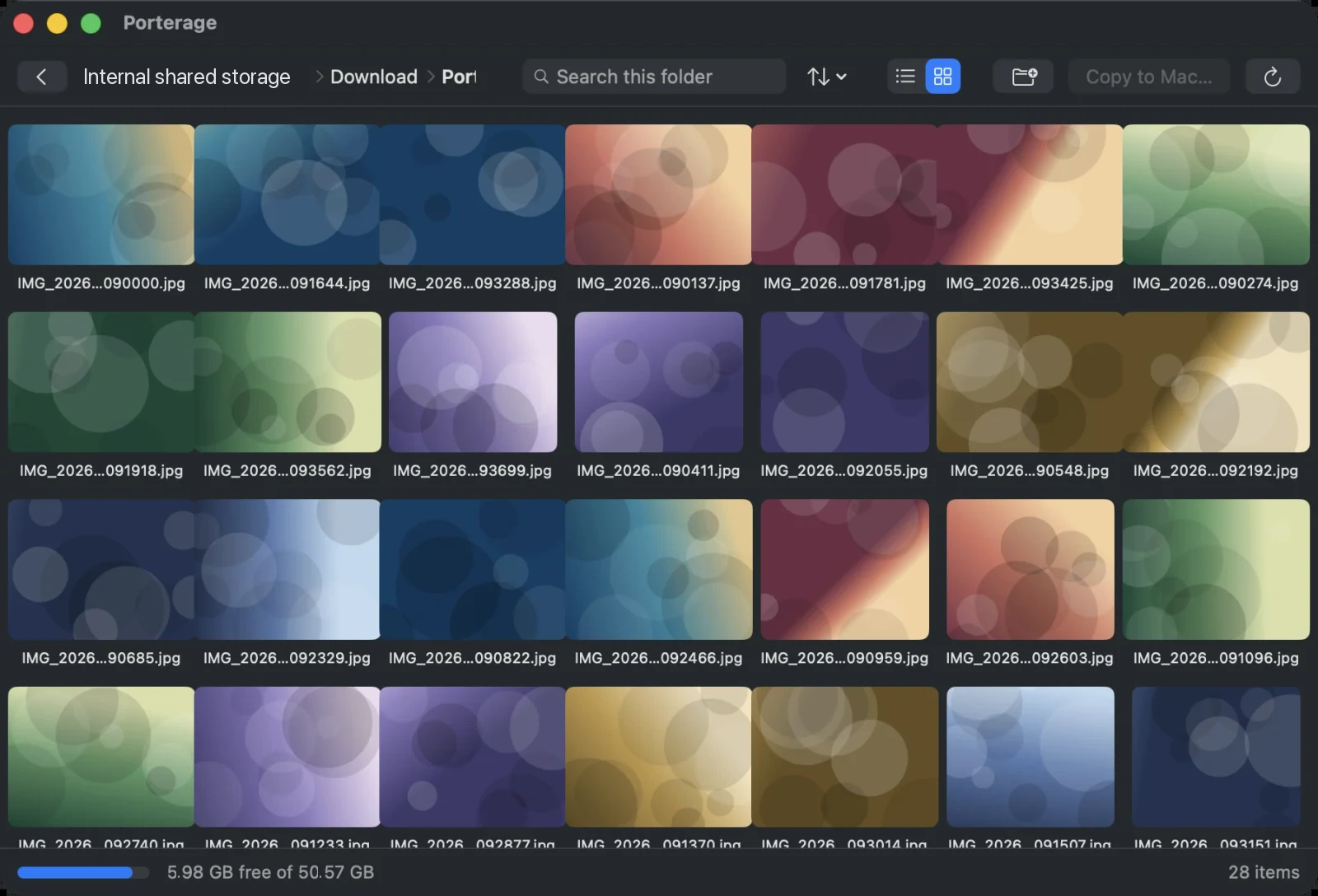
- Browse the phone as a list or as a grid of thumbnails. Drag files out to the Finder, or drop files onto a folder to copy them to the phone.
Copy, and know what to expect
A few things about copying look like faults the first time you meet them. Only the third one is.
The first folder is slow
Right after you plug in, the phone builds an index of everything on its storage before it answers. Let it finish; unplugging starts it over.
Both bars share one scale. The test phone held about 34,000 files and folders.
Copying onto the phone is half the speed
Scale 0–40 MiB/s. 324 real photos, 2 GiB in all, came off in 79 seconds — about four minutes for a thousand.
Hundreds of small files can stall the connection
The phone raises a notice for every file written to it. A tool that never reads those notices slows down as they pile up, and at roughly 211 files the phone stops answering altogether. A software reset does not bring it back; only unplugging the cable does. Porterage reads the notices as it goes.
Same phone, same 400 small files. Unread, it stopped answering for good at about 211.
Three more things worth knowing
- Dates survive one way. Files copied to the Mac can keep their original date. Files copied onto the phone get the phone's current time, and it refuses to be told otherwise.
- Names that differ only in capitals collide. The phone's storage treats
Report.txtandreport.txtas one file, so copying the second silently replaces the first. - The phone accepts files that will not fit. Offered a file far larger than its free space, it starts taking the data anyway. Its free-space figure is exact, so check it before a big copy.
Still not working
Find what you are seeing, then go back to the stage it points at.
| What you see | What it usually means | Go to |
|---|---|---|
| The phone charges and the Mac shows nothing | Charging-only mode, or a cable that only charges | 2 · USB mode1 · Cable |
| Image Capture sees photos, but an app finds no phone | The phone is set to Transfer photos (PTP) | 2 · USB mode |
| The phone is detected, but its storage is empty or "not connected" | The screen is locked | 3 · Unlock |
| An app says the phone is busy or in use | Another app on the Mac already holds it — quit OpenMTP or Android File Transfer | 4 · Method |
| It worked, then stopped answering during a batch of small files | The connection has stalled. Unplug and replug the cable | 5 · Copy |
| The first folder takes around 17 seconds to open | Normal: the phone is indexing its storage | 5 · Copy |
An app that tells you which stage is wrong
Porterage tells a locked screen apart from the wrong USB mode, reads the phone's notices so big batches keep moving, and resumes an interrupted copy at the exact byte. Free and open source.